Quick Answer
This guide compares the best indoor grow lights under £100 — covering LED panels, T5 fluorescents, and quantum boards — helping beginner urban farmers choose the right light for their plants and budget. --- What should you look for when buying a grow light under £100? Choosing a grow light is one of the most consequential decisions for an indoor…

Some links in this article are affiliate links. If you purchase through them, we may earn a small commission — at no extra cost to you.
This guide compares the best indoor grow lights under £100 — covering LED panels, T5 fluorescents, and quantum boards — helping beginner urban farmers choose the right light for their plants and budget.
What should you look for when buying a grow light under £100?
Choosing a grow light is one of the most consequential decisions for an indoor garden. A poor choice leads to leggy, weak plants; a good one produces dense, healthy growth on minimal power draw.
Actual wattage vs rated wattage. Many budget lights advertise inflated wattages. A light "rated" at 1000W may only draw 100W from the wall. Always look for the true watt draw, which tells you how much electricity the light actually consumes and how much light it actually produces.
Coverage area. A 45W panel may cover a 2×2 ft seedling tray adequately, but struggle over a 3×3 ft vegetative canopy. Manufacturers' coverage claims are often optimistic — budget for about 30–50W of true draw per square foot for fruiting crops, 20–30W for leafy greens.
Light spectrum. Full-spectrum white LEDs work well for most crops. If the light has a visible blue/red "blurple" spectrum, check whether it includes green wavelengths, which are important for canopy penetration. Modern quantum board LEDs use Samsung LM301 or similar diodes and produce a high-quality full-spectrum output.
Heat output and cooling. Cheaper lights often lack heatsinks, leading to diode degradation and shorter lifespans. Passively cooled quantum boards last longer than fan-cooled panels because fans fail first.
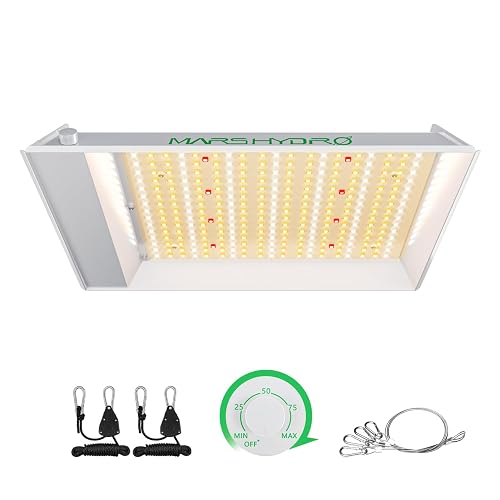
Build quality and warranty. At this price point, expect 1–2 year warranties. Brands like Mars Hydro, Spider Farmer, and Vivosun offer reasonable warranty support for budget products.
What are the best indoor grow lights under £100 in 2026?
| Product | True Wattage | Coverage | Price | Best For | Rating |
|---|---|---|---|---|---|
| Spider Farmer SF-1000 | 100W | 2×2 ft (veg) / 1.5×1.5 ft (flower) | ~£95 | Small tents, herbs, leafy greens | 4.7/5 |
| Mars Hydro TS 600 | 90W | 2×2 ft | ~£55 | Seedlings, microgreens, small herb gardens | 4.5/5 |
| Vivosun VS1000 | 100W | 2×2 ft | ~£75 | Beginner tent growers | 4.4/5 |
| Barrina T5 4ft 96W | 96W | 4×1.5 ft strip | ~£50 | Seedlings, clone trays, low-clearance shelving | 4.3/5 |
| Roleadro 75W COB LED | 75W | 1.5×1.5 ft | ~£45 | Single plant herb growing | 4.0/5 |
Spider Farmer SF-1000 is the top pick under £100. It uses Samsung LM301B diodes — the same diodes found in lights costing three times as much — with a passively cooled aluminium board. The full-spectrum output is excellent for both vegetative and early flowering stages. It runs cool and quiet with no fans to fail.
Mars Hydro TS 600 is the best value under £60. It draws 90W from the wall, covers a 2×2 ft footprint for vegetative growth, and is a solid choice for beginners growing herbs, lettuces, and microgreens on a tight budget.
Vivosun VS1000 sits between the two in both price and performance. Vivosun's customer support is consistently rated well, which matters when buying budget equipment that may occasionally need replacement parts.
Barrina T5 strips are worth including because they fill a different niche: low-profile shelf growing, seed starting trays, and propagation. Four 2-foot strips cover a standard nursery flat at the correct distance and are ideal for starting seeds before transferring plants to a more powerful light.
Roleadro COB is a bare-minimum option for growing a single basil plant or small herb pot on a windowsill. At £45, it is the cheapest functional option in this list, but the coverage is limited.
How do grow lights compare for beginners vs advanced growers?
For beginners growing herbs, lettuces, and microgreens, the Mars Hydro TS 600 or Barrina T5 strips are ideal starting points. They are forgiving about placement distance, run at safe temperatures, and the plants most beginners start with — basil, spinach, coriander, mint — do not demand the intense light that fruiting crops do.
For intermediate growers adding tomatoes, peppers, or strawberries to their indoor garden, the Spider Farmer SF-1000 or Vivosun VS1000 become more relevant. These plants need higher PPFD (photosynthetic photon flux density) at canopy level — 400–600 µmol/m²/s for tomatoes vs 200–300 for leafy greens.
Advanced growers growing dense canopies or running a 4×4 ft tent will typically need to spend beyond £100, as even two SF-1000s pushing the budget would be underpowered for a full 4×4 ft flowering canopy. For anything larger than 2×2 ft of serious growing, budget £150–£250 and look at the Spider Farmer SF-2000 or Mars Hydro TSW 2000.
Are there budget grow light options worth considering under £50?
Yes, several options deliver adequate performance under £50 for the right applications.
The Mars Hydro TS 600 at ~£55 occasionally drops below £50 during sales and is the strongest true performer in this range. For seedling trays and microgreens, it is hard to beat.
Barrina T5 LED shop lights (4-pack, 2ft, ~£30–45) are the most cost-effective option for propagation shelves, seed starting, and growing lettuces hydroponically on wire shelving units. They are not designed specifically as grow lights, but their 6500K colour temperature is suitable for vegetative growth and seedlings.
Roleadro and other generic Amazon panels under £40 exist in large numbers. Most draw 30–50W from the wall despite claiming much higher wattages. They work for a single small plant or seedling tray but should not be expected to perform beyond that. Check the actual watt draw in the product description before purchasing.
Avoid any panel claiming 1000W, 2000W, or 3000W for under £50 — these are misleading marketing figures. Real wattage will be in the 30–60W range, which is fine for limited use but should be understood clearly.