Quick Answer
Soilless strawberries produce sweeter, cleaner fruit than soil-grown plants because drainage and root health are precisely controlled. Using cold-chilled runners and EC 1.0–1.4 with a potassium-heavy fruiting formula, expect first ripe fruit 60–90 days after planting, with continuous harvest for 6–8 months. --- Why do strawberries perform better in soilless systems? Strawberries ( Fragaria × ananassa ) are uniquely suited…
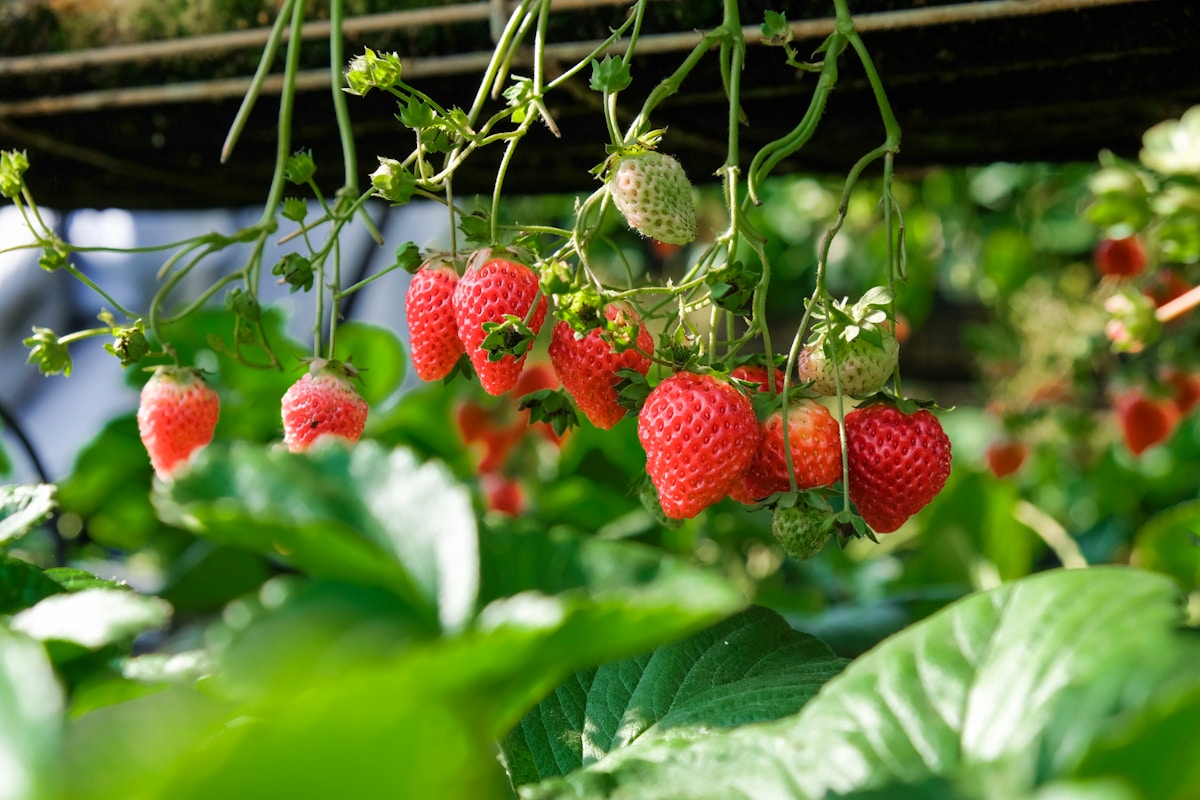
Soilless strawberries produce sweeter, cleaner fruit than soil-grown plants because drainage and root health are precisely controlled. Using cold-chilled runners and EC 1.0–1.4 with a potassium-heavy fruiting formula, expect first ripe fruit 60–90 days after planting, with continuous harvest for 6–8 months.
Why do strawberries perform better in soilless systems?
Strawberries (Fragaria × ananassa) are uniquely suited to soilless cultivation, and commercial greenhouse strawberry production has largely displaced field production in northern Europe for this reason. The plant's natural biology makes it almost ideal for hydroponic methods.
In soil, strawberries are chronically vulnerable to root diseases — particularly Phytophthora root rot and Verticillium wilt — because they require simultaneously moist and well-drained conditions that are difficult to maintain in field soil. Soilless systems deliver precisely this balance: roots are consistently moist in nutrient solution, with excellent oxygenation in NFT channels or well-drained coco coir.
The second advantage is control over flavour. Strawberry sweetness (measured as Brix) is directly correlated with potassium levels during fruit development and mild water stress in the final 7–10 days before harvest. In a soilless system, you can engineer both of these conditions with precision.
The third advantage is hygiene. Soil-grown strawberries require heavy pesticide programmes against soil-borne pests and foliar fungi that thrive in field conditions. Controlled-environment soilless production dramatically reduces this burden.
How do you propagate strawberries for a soilless system?
This is the most important decision in soilless strawberry production: use runners, not seeds.
Runners (stolons) are horizontal stems the mother plant sends out horizontally, which root at nodes and become new plants. These are genetically identical clones of the mother and will produce fruit true to variety. Purchasing bare-root runners or cold-chilled plug plants from a specialist nursery is strongly recommended.
Cold-chilling runners: Commercial operations chill bare-root runners at 1–2°C for 3–6 weeks before planting. This forces dormancy-breaking, stimulates vigorous root growth upon planting, and compresses the time to first flower. If you receive fresh runners in summer, chilling them in the refrigerator (not freezer) for 4 weeks before planting in late winter gives a significant production advantage.
Why not seeds? Strawberry seeds are genetically variable — plants grown from seed will not reliably reproduce the flavour, size, or yield of the parent. Seed-grown strawberries also take 12–18 months to produce their first fruit. Runners are universally preferred in commercial and serious home production.
Planting into soilless media: Plant runners into 5–10 cm net pots filled with coco coir, or directly into NFT channels. The crown (the point where roots meet the stem) must sit at the media surface — not buried and not elevated. A buried crown rots; an elevated crown desiccates.
How do you nurture strawberry plants through vegetative establishment?
The first 3–4 weeks after planting are critical — the plant is establishing roots and building the leaf canopy that will support fruiting.
Nutrient parameters by phase:
| Phase | EC (mS/cm) | Key Nutrients | Duration |
|---|---|---|---|
| Establishment (post-planting) | 0.6–1.0 | Nitrogen-balanced, phosphorus for roots | Weeks 1–3 |
| Vegetative (full leaf expansion) | 1.0–1.2 | Balanced NPK, calcium and magnesium | Weeks 3–6 |
| Pre-flowering | 1.2–1.4 | Reduce nitrogen, raise phosphorus | Weeks 6–8 |
| Fruiting (continuous) | 1.2–1.6 | High potassium, maintain calcium | Week 8 onwards |
pH: 5.5–6.0 throughout. Strawberries prefer a slightly acidic nutrient environment and are more sensitive to high pH than most crops — above pH 6.5, iron and manganese deficiency appear within 2 weeks.
Temperature: 15–22°C day, 8–12°C night. The cool night temperatures are important for flower initiation and fruit quality. Warm nights (above 18°C) reduce fruit size and Brix.
How do you care for soilless strawberries during fruiting?
Runner removal: Strawberry plants continuously produce runners during their vegetative phase. All runners must be removed in a fruiting plant — they divert enormous energy from fruit production. Remove cleanly at the base with scissors. This single management task has the largest impact on yield.
Everbearing versus June-bearing varieties:
- Everbearing varieties (Albion, Seascape, Evie, Portola) produce fruit continuously across spring, summer, and autumn under adequate light. They are the strongly preferred choice for soilless systems because they provide year-round production without seasonal breaks.
- June-bearing varieties (Elsanta, Sonata, Camarosa) produce one large flush of fruit over 3–4 weeks in June/July, then stop until the following season. They are used in commercial field production for concentrated harvest but are less efficient in indoor soilless systems.
Pest monitoring: Controlled-environment strawberries are vulnerable to two-spotted spider mites (Tetranychus urticae), which thrive in warm, dry conditions. Inspect the underside of leaves weekly. Introduce predatory mites (Phytoseiulus persimilis) preventatively rather than reactively. Aphids and whiteflies are secondary concerns.
Flower and fruit development: Strawberry flowers are self-fertile but benefit from vibration for pollen release. Hand pollination with a soft paintbrush or electric toothbrush increases fruit set and reduces misshapen fruit. Misshapen or "catfaced" strawberries typically result from incomplete pollination or calcium deficiency during fruit development.
How do you harvest soilless strawberries?
Colour versus flavour timing: Strawberries stop accumulating sugars from the plant once they reach full colour — however, the development of full strawberry aroma compounds (esters and terpenes) continues for several days after full colour. The visual signal for peak flavour is full red coloration with slight softening at the tip and the characteristic scent noticeable when you hold the fruit near your face.
Practical harvest technique:
- Harvest with a 1–2 cm stem attached; never pull the berry off the stem.
- Handle carefully — soilless strawberries are slightly softer than field-grown due to optimal hydration.
- Harvest in the morning.
Storage: At room temperature, ripe strawberries last 1–2 days. Refrigerate at 2–4°C and consume within 4–5 days. Do not wash until just before eating — moisture accelerates surface mould.
What nutritional value do soilless strawberries provide?
Strawberries are among the most nutritionally remarkable fruits per calorie — particularly for vitamin C and antioxidant content.
| Nutrient | Per 100g Fresh | % Daily Value | Notes |
|---|---|---|---|
| Vitamin C | 59 mg | 65% | One of the highest of any fruit; higher than oranges per gram |
| Manganese | 0.39 mg | 17% | Supports bone development and antioxidant enzyme function |
| Folate (B9) | 24 µg | 6% | Cell division and cardiovascular health |
| Potassium | 153 mg | 3% | Cardiovascular support |
| Anthocyanins | 15–40 mg per 100g | — | Primary antioxidant; cardioprotective, anti-inflammatory |
| Ellagic acid | Present | — | Polyphenol with documented antiproliferative research |
Soilless concentration advantage: Several studies have found that strawberries grown in substrate systems (coco coir, perlite) with high-potassium fruiting nutrients and mild water stress in the final week before harvest achieve 10–20% higher Brix (sugar content) and measurably higher anthocyanin concentration compared to field-grown fruit. The flavour difference is perceptible in blind tasting.
Frequently Asked Questions
Do hydroponic strawberries taste as good as field-grown?
Can I grow strawberries from seeds hydroponically?
How long before I see the first ripe fruit from soilless strawberries?
Some links in this article are affiliate links. If you purchase through them, we may earn a small commission — at no extra cost to you.
 General Hydroponics Flora Series 3-Part Nutrient System (1 qt each)
 General Hydroponics pH Control Kit (pH Up, pH Down, Test Indicator)
 INKBIRD WiFi Thermometer Hygrometer IBS-TH5 (9-in-1, 2-Year Data Storage)
 AeroGarden Bounty Elite (9-pod)General Hydroponics Flora Series 3-Part Nutrient System (1 qt each)
 GROWNEER 50-Pack 2-Inch Slotted Mesh Net Pots
 Apera Instruments PC60 pH/EC/TDS/Temp MeterGeneral Hydroponics pH Control Kit (pH Up, pH Down, Test Indicator)
 Bluelab pH 4.0 and 7.0 Calibration Solution Kit (500 ml each)
